Mold & Water Damage Restoration in Metro AtlantaPure air. Dry surfaces. Mold and root causes gone.
Certified mold remediation, water damage restoration, and root-cause solutions for Metro Atlanta homes and commercial buildings. You’ll know exactly what’s wrong before any work begins.
Prefer to dial? (470) 993-0773. Same 24/7 line.
What kind of property is it?
- 24/7/365Questions, estimates, and emergencies
- Homes and businessesResidential, commercial, and industrial
- We come to youAnywhere in Metro Atlanta
- Assessment firstNo pressure, no unneeded work
Who We Serve
Same certified work for every property. Built around what you're responsible for.
Your home should be the safest air your family breathes
You don't need to know what to call the problem. If something in your house isn't right, we'll find out what it is and whether it needs fixing.
A musty smell you can't place
Earthy or stale odor that comes back no matter how much you clean.
Spots on walls or ceilings
Dark patches, discoloration, or fuzzy growth, especially near bathrooms, windows, or the attic.
A damp crawlspace or basement
One of the most common problems in Metro Atlanta homes, and it affects the air in every room above it.
A leak that may not have dried
A burst pipe, roof leak, or flood that was cleaned up, but you're not sure it was done right.
We'll tell you if you don't need us
Not every problem needs remediation. If yours doesn't, you'll hear that from us first. If it does, we'll tell you whether you need to leave home during the work and how long it will take before anything starts.
Protect your tenants, your operation, and your paper trail
A mold or moisture problem in a commercial building is a liability question as much as a health one. We give you findings you can act on and documentation you can defend.
Tenant or employee complaints
Odor, air quality, or health complaints you need to investigate and respond to in writing.
Water intrusion or a failed system
Roof leaks, HVAC condensation, or plumbing failures that may have spread behind finishes.
Insurance and legal documentation
Written reports with independent lab results, suitable for claims, counsel, and regulators.
Keeping the building open
Remediation planned around your operating hours, with containment that keeps work areas separate.
Clearance you can prove
Every remediation ends with post-remediation verification testing, so the file shows the problem was found, fixed, and confirmed. Not just that someone cleaned it.
Our Services
Residential and commercial mold remediation and water damage restoration. Choose your property type, then tap any service for the details that apply to you.
Mold inspection and testingFind out whether mold is present, what kind, where it is, and how far it has spread.
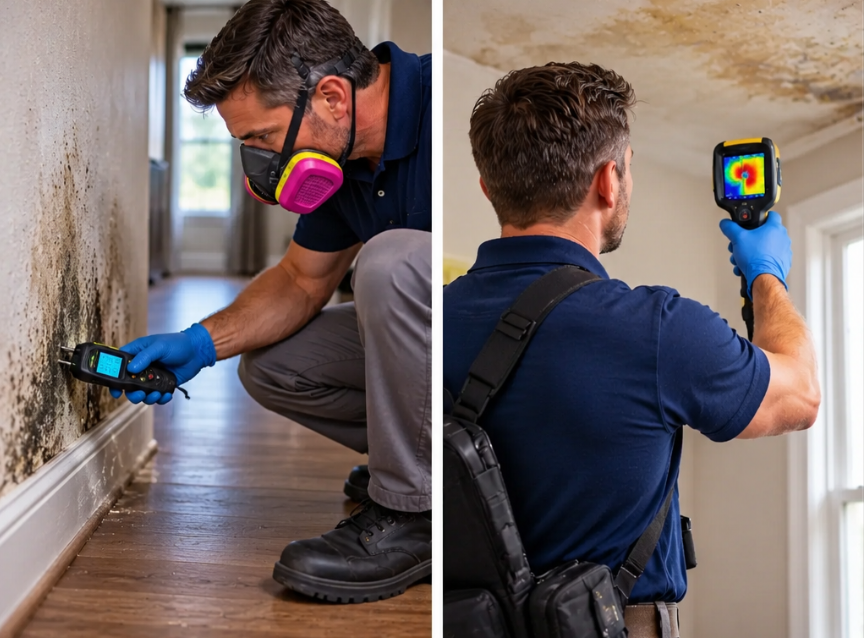
For homes: We check behind the musty smell: walls, attic, crawlspace, and HVAC. If sampling will help, an independent lab analyzes it, and you get a plain-language report on what's there and whether it needs fixing.
For commercial & industrial: Documented inspections for occupant complaints, due diligence, and insurance claims. Samples go to an accredited third-party lab, and the written report is one your insurer, counsel, and tenants can rely on.
Mold remediationContained, standards-based removal, finished with clearance testing.
For homes: We fix the moisture source, seal off the work area so spores don't travel through your house, remove what can't be cleaned, and test before we call it done. You'll know up front whether your family needs to stay elsewhere during the work.
For commercial & industrial: Containment and negative air pressure keep the rest of the building occupied and running. Work is scheduled around your operating hours, and post-remediation verification is documented for your file.
Water damage restorationFast structural drying after leaks and floods, before mold gets a start.
For homes: Burst pipe, roof leak, or an overflowing appliance: we dry the structure and your materials quickly, and show you the moisture readings that prove it's dry.
For commercial & industrial: Structural drying for offices, retail, and warehouse space, with moisture readings documented throughout for insurance and property records.
Crawlspace and basement moistureStop the moisture under your floors that feeds mold, rot, and pests.
For homes: Georgia humidity makes damp crawlspaces common. We find where the water comes from and fix it, protecting your floors, your framing, and the air your family breathes upstairs.
For commercial & industrial: Basements, below-grade spaces, and mechanical rooms assessed for water intrusion and humidity, with corrections that protect the structure and anything stored there.
Moisture and humidity controlFind and correct the conditions that let mold grow in the first place.
For homes: Foggy windows, sticky rooms, sweating ductwork. We measure humidity room by room and fix the cause, not just the symptom.
For commercial & industrial: HVAC condensation, building envelope leaks, and humidity problems diagnosed across large spaces, with recommendations your maintenance team or mechanical contractor can act on.
Indoor air quality testingMeasure what's in the air and get clear next steps.
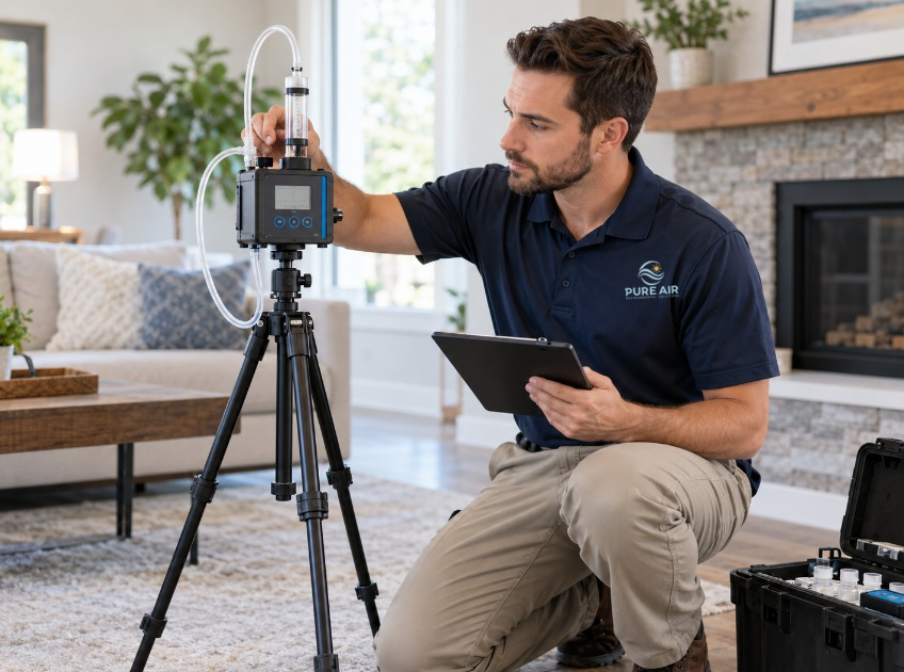
For homes: If your family feels better away from home, we measure what's in your air and tell you what, if anything, needs to change.
For commercial & industrial: Air quality assessments in response to occupant complaints or as a baseline, with documented results for tenants, HR, and property management.
What we test for
- Mold spores
- Allergens and fine particles
- Humidity levels
How it works
- Samples from the rooms of concern
- An outdoor sample for comparison
- Analysis by an accredited, independent lab
- A plain-language report with clear next steps
Odor investigationTrack down persistent, unexplained odors and treat the source.
For homes: A smell that keeps coming back usually has a source. We find it, whether that's hidden mold, trapped moisture, or something else, and treat it.
For commercial & industrial: Persistent odors drive tenant complaints and vacancies. We identify the source and treat it with as little disruption to your operation as possible.
Property condition assessmentsIndependent environmental reports before you buy, sell, lease, or refinance.
For homes: Buying a home? Know what you're getting before closing. Selling? Show buyers the home has been checked by an independent professional.
For commercial & industrial: Environmental condition assessments for acquisitions, leases, and refinancing, documented for lenders, buyers, and ownership groups.
From first question to verified clean
Ask
Talk or text with us any time. Describe what's happening and book an inspection on the spot.
Inspect
We inspect the property to find visible growth, moisture, and what's causing it.
Test
When needed, samples go to an accredited, independent third-party lab.
Report
A written report in plain language, with honest options. Not every case needs remediation.
Fix and verify
Contained remediation, then clearance testing before we call the job done.
Questions we hear most
Plain-language answers, based on EPA and industry guidance.
What happens when I click "Talk or Chat Live Now"?
A window opens with our 24/7 assistant. Talk or type, whichever you prefer: it answers questions about your situation and books your inspection, no form needed. Calling (470) 993-0773 reaches the same line.
How do I know if I have a mold problem?
Common signs include a persistent musty odor, visible spots or growth, water damage that wasn't completely dried, high indoor humidity, or symptoms that ease when you leave the building. An inspection is the only reliable way to know.
Do you actually need mold testing?
Not always. The EPA's guidance is that if you can see mold, sampling usually isn't needed to decide it should be removed. There are also no federal standards for an "acceptable" level of mold spores, so a lab number by itself doesn't settle much.
Testing earns its cost when you suspect hidden mold (a persistent odor or symptoms with nothing visible), when you need proof that remediation worked (clearance testing), or when a sale, lease, insurance claim, or legal matter requires documentation.
When you do test, make sure samples go to an accredited, independent laboratory, and ask for results explained in plain language.
Is all mold dangerous?
Not all species carry the same risk, but any mold growing inside a building should be taken seriously. Inspection and testing tell you exactly what you're dealing with.
Why mold grows, and why Georgia is prime territory
Mold needs three things: moisture, something to feed on (drywall paper, wood, dust), and time. Mold spores are already everywhere, indoors and out, so you can't keep them away. What you can control is moisture.
According to the EPA, mold can begin growing within 24 to 48 hours after materials get wet. Metro Atlanta's long, humid summers keep many homes and buildings close to that line. The EPA recommends keeping indoor humidity below 60 percent, ideally between 30 and 50 percent.
The takeaway: fix the moisture and you fix the mold. Remove the mold without fixing the moisture, and it comes back.
After a leak or flood: the first 48 hours
Stop and stay safe. Shut off the water source, and keep away from standing water near outlets or appliances until the power is off.
Document everything. Take photos and video before you move or throw anything out, then call your insurance company.
Start drying immediately. The EPA advises drying wet materials within 24 to 48 hours to prevent mold. Wet drywall, insulation, and carpet pad often can't be saved and need to come out.
Know your water. The restoration industry sorts water into three categories: clean (a supply line), gray (a washing machine or dishwasher), and black (sewage or outdoor floodwater). Black water carries serious contamination and calls for professional cleanup.
Your crawlspace affects the air you breathe
Warm air rises through a house and pulls air up from below it. That means crawlspace air, including its moisture and musty odors, can end up in your living space.
Warning signs include a musty smell on the first floor, cupping or soft hardwood, sagging floors, condensation on ductwork, and pests. Standing water, wet insulation, or visible growth on floor joists means the problem is already established.
Common fixes include correcting drainage and grading, installing a vapor barrier, and, in humid climates like ours, sealing and dehumidifying the crawlspace instead of relying on open vents that let in moist summer air. The right fix depends on where the water is coming from, so start with an assessment.
DIY cleanup or call a professional?
The EPA says homeowners can often handle a moldy area smaller than about 10 square feet, roughly a 3-by-3-foot patch. Fix the moisture first, scrub hard surfaces with detergent and water, dry them completely, and wear an N-95 respirator, gloves, and eye protection. Porous items like ceiling tiles and carpet may need to be thrown out. Don't paint or caulk over mold; it keeps growing underneath.
Call a professional when the area is larger than 10 square feet, when mold is in your heating or cooling system, after sewage or floodwater, when mold keeps coming back after cleaning, when someone in the home has asthma or a weakened immune system, or in any commercial building with occupants.
How long does remediation take, and do I need to leave?
A small contained area often takes one to two days; larger jobs take longer. Whether you need to leave depends on the location, extent, and type of growth. You'll get a realistic timeline and a clear answer during your assessment, before any work starts. For commercial properties, we plan the work around your operating schedule.
Have a question that isn't covered here? Talk or chat with us, day or night. More from the EPA at epa.gov/mold.
About Us
Most people call us because something smells wrong, looks wrong, or feels wrong, and they don't know what it is. That's exactly the right time to call.
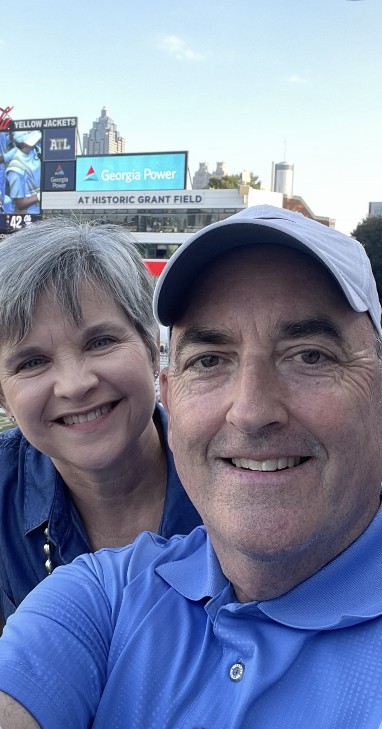
Brian Cunningham has spent more than a decade building a contracting business in Gwinnett and DeKalb counties. He lives here, works here, and knows firsthand what Georgia's heat, humidity, and sudden downpours do to a home.
That experience taught him a lesson that applies to every property problem: fix the root cause, not just the surface. A stained ceiling, a musty basement, a damp crawlspace. Each one is a symptom. Brian founded Pure Air to rid every home, commercial, and industrial work site of harmful mold growth by finding the environmental root cause behind it and fixing it for good.
He also knows what property owners are tired of: rushed work, surprise upsells, and contractors who disappear. So Pure Air does the opposite. We show up when we say we will. We explain what we found in plain language. We recommend only what your property actually needs. And we treat every home and building as if it were our own.
Assessment before any recommendation
You'll know what's actually wrong before we talk about fixing it. Sometimes the answer is that you don't need us.
Plain language, no scare tactics
Our reports explain what we found, where, and what it means, in words you don't need a dictionary for.
Proof, not promises
Independent lab analysis when testing is needed, and clearance testing before any remediation job is called complete.
Certified to do it right
Certified Mold Remediation Contractor (CMRC)
Mold Inspection Consulting and Remediation Organization (MICRO)
Trained in containment, removal methods, HVAC and contents remediation, and worker protection.
Certified Mold Inspector (CMI)
Mold Inspection Consulting and Remediation Organization (MICRO)
Trained to find mold, trace the moisture behind it, and sample the air following EPA and industrial hygiene guidelines.
Water Damage Restoration Technician (WRT)
Institute of Inspection, Cleaning and Restoration Certification (IICRC)
Trained in water damage categories, drying science, and restoring structures after leaks and floods.
Goldmorr Master Technician
Goldmorr System
Certified in the Goldmorr System of mold remediation and air quality treatment, available only to trained professionals.
Our Service Area
Serving all of Greater Metro Atlanta, at your home or business.
- Fulton CountyAtlanta, Alpharetta, Roswell, Sandy Springs
- DeKalb CountyDecatur
- Gwinnett CountyLawrenceville, Snellville, Duluth, Norcross
- Cobb CountyMarietta, Kennesaw, Smyrna
- Cherokee CountyWoodstock
- Forsyth CountyCumming
- Clayton CountyJonesboro
- Fayette CountyPeachtree City
- Henry CountyMcDonough, Stockbridge
- Rockdale CountyConyers
- Newton CountyCovington
- Walton CountyLoganville, Monroe
Not sure if we cover your property? Tap Talk or Chat Live Now and ask. We'll answer immediately.
Get answers tonight, not next week
Tap Talk or Chat Live Now and talk or text with us right now. Ask questions, get a sense of what you're dealing with, and book an inspection in the same conversation.
- Phone, 24/7(470) 993-0773
- Email[email protected]
Prefer a form?
Send us the details and we'll reach out.